Rebuilding My CV and Portfolio From Scratch With Claude
After a year of full-time backend development, I’m making a deliberate career switch back to my roots in mobile. It’s a challenging transition, so I built a concrete, step-by-step plan—using Claude as my collaborator—to overhaul my CV, portfolio, and interview prep from scratch.
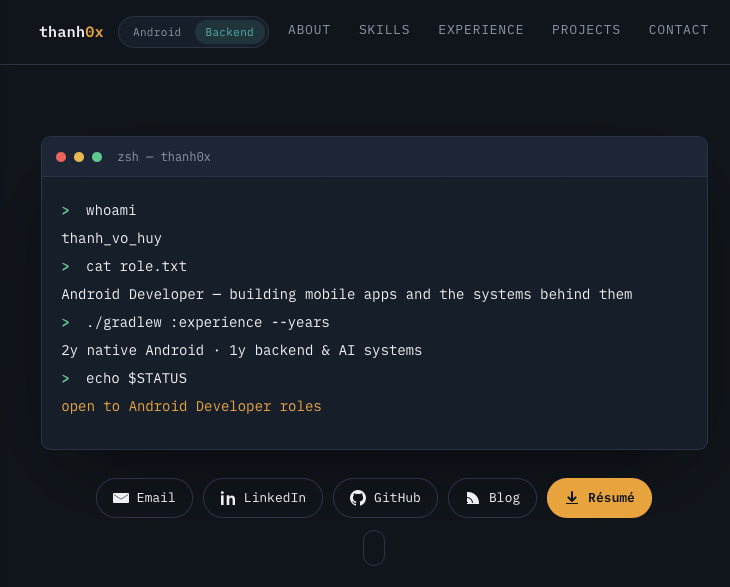
After a year of full-time backend development, I’m making a deliberate career switch back to my roots in mobile. It’s a challenging transition, so I built a concrete, step-by-step plan—using Claude as my collaborator—to overhaul my CV, portfolio, and interview prep from scratch.
Back story
My career has never been a straight line. I studied Computer Science, graduated a year early, spent 9 months building Python automation tools as a freelancer, and then joined a Japanese company as an Android developer. For two years, I built native Android apps for a 2-million-user English-learning platform.
When that project ended, I faced a choice: wait for a matching mobile project or pivot to backend development. Driven by my ambition to become a true solo developer who can build a product from the database to the UI, I chose backend.
A year later, I’ve mastered server-side development, but I miss mobile deeply. Combining backend knowledge with mobile expertise completes my solo dev toolkit. However, stepping back into Android after a year away means bridging a fast-moving ecosystem gap. That’s why I needed a rigorous preparation strategy rather than just throwing my old resume together.
The 5-Step Plan
- The Brain Dump: I used speech-to-text to dictate my entire career timeline, letting Claude organize the raw history.
- The JD Analysis: I gathered 8 target job descriptions from companies matching my desired culture and stack.
- The Gap Analysis: Claude cross-referenced my career journal with the JDs to highlight my strengths and prioritize missing skills.
- The Target CV: We built a CV not just reflecting past work, but targeting those specific requirements.
- The Portfolio: We translated that professional narrative into a clean web layout.
From Resume to Reality: The 12-Step Implementation Roadmap
Having a great CV is one thing; making sure my skills actually back it up is another. Because I’m bridging the gap between my current backend experience and my return to mobile (Kotlin Multiplatform), I mapped out a strict 12-step roadmap to turn every claim on my resume into working, production-ready code.
Detailed Step Breakdown
- Step 1 — Finish the Manifest Interview Question book (~15–25 hrs): actively re-learn rusty concepts to close knowledge gaps and prepare the fundamental for the internview
- Step 2 — Redesign the Figma file (~10–20 hrs): Build out the full UI layout (list, detail, search, preferences, auth screens, settings) using AI like Claude Design or Figma Make
- Step 3 — Confirm backend is stable and connectable (~5–10 hrs): Verify API and Crawler containers on Proxmox, test endpoints, and ensure a clean baseline before touching app code.
- Step 4 — Android dependency update & verification (~10–20 hrs): Update Gradle/libraries, map endpoints against the backend, and manually verify the legacy View-based app is fully functional.
- Step 5 — Rename repos and packages (~5–10 hrs): Clean up repository names, app package names, and user-facing strings.
- Step 6 — Compose migration, Android only (~60–100 hrs): Complete official Google codelabs and migrate screens to Jetpack Compose using AI assistance. No more DataBinding/LiveData/legacy Navigation.
- Step 7 — Rich-Text Rendering Library → JitPack (~40–70 hrs): Rebuild the custom paragraph/intonation rendering logic independently in Kotlin, wrap it as a Compose Canvas library, and publish to JitPack.
- Step 8 — Compose Multiplatform, Android + iOS (~40–70 hrs): Introduce the KMP module structure, add the iOS target via Kotlin-Native interop, and share UI logic across both platforms.
- Step 9 — Search, Preferences, and CRUD (~20–35 hrs): Wire up full read/write CRUD operations against the live backend.
- Step 10 — Auth & Notification Preferences (~45–70 hrs core): Implement Google/Apple login on both backend and client, build the user preference model, and set up FCM coupon-match push notifications. (Optional WebSocket real-time stretch deferred).
- Step 11 — Supporting tech stack (~40–65 hrs): Integrate versioning, Firebase Crashlytics, meaningful unit tests (JUnit + Mockito), GitHub Actions CI, and Fastlane.
- Step 12 — Publish & Web Rebuild (~25–50 hrs): Push to F-Droid (primary), optionally prep TestFlight, and rebuild a lightweight web frontend (list/detail/search only) using documented references.
The Results
- Portfolio: thanh0x.com
- CV: thanh0x.com/assets/Thanh_VoHuy_Android_Resume.pdf
- Source Code: GitHub - thanh0x.com Portfolio src code